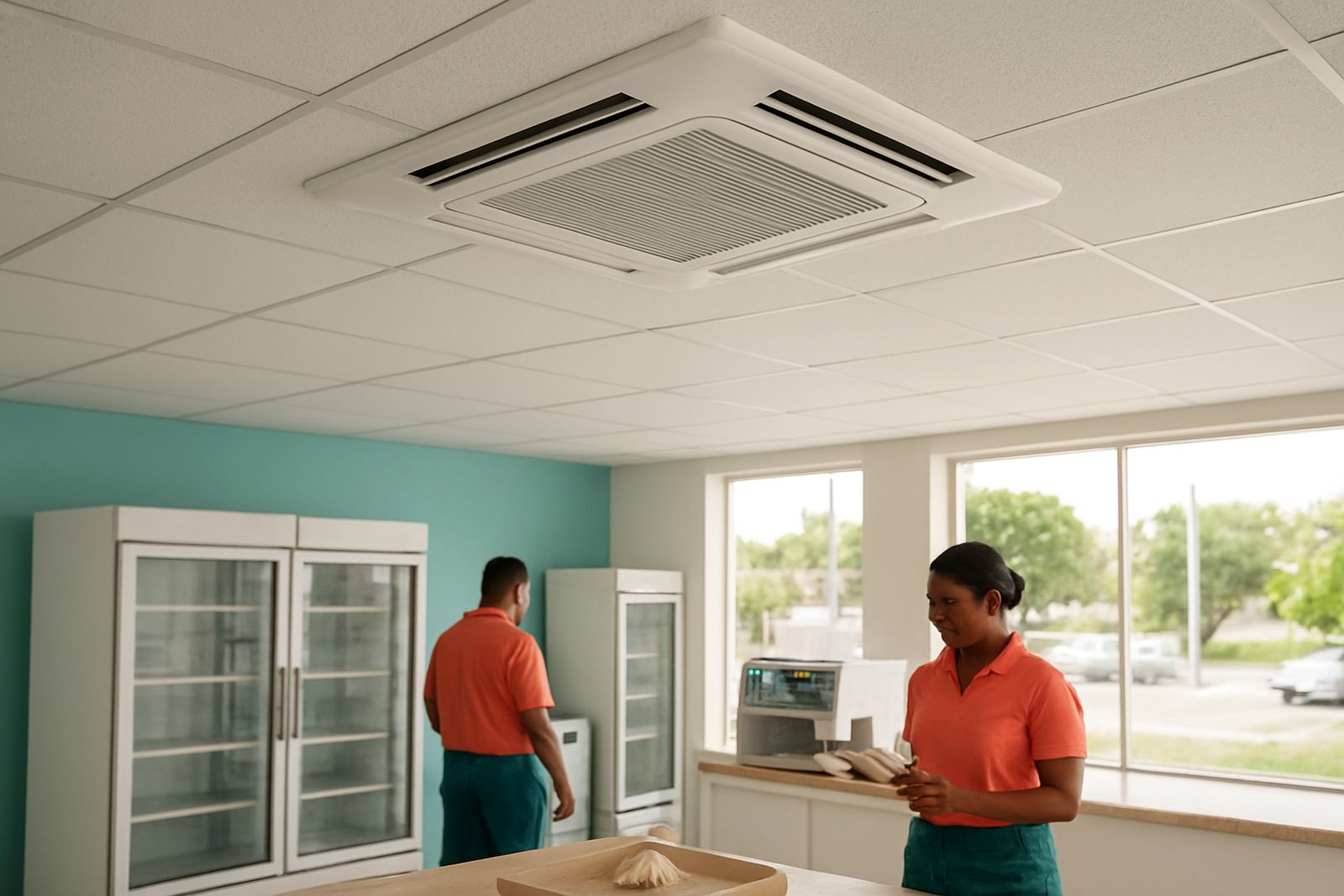
What ventilation fans do in a working building
Ventilation fans move used air out and bring fresh air in, so a room does not trap heat, cooking vapour, dust or light fumes. In a kitchen this helps clear steam and grease haze. In a storeroom or workshop it reduces stuffiness and keeps the area more workable through the day. In plant rooms and service spaces it also helps stop hot air from sitting around pumps, motors and electrical gear.
We supply fans for supply air, extract air or a mix of both depending on the space. The fan type, blade size and motor power all matter. A small back-of-house store may only need a single wall fan, while a commercial kitchen or packaging area may need ducted extraction with proper make-up air. If the wrong fan is fitted, the room can still overheat, doors can slam from pressure changes, and the motor may work too hard.
In coastal areas like Durban North, Umhlanga and Ballito, salty air and humidity can shorten the life of cheap metal parts. That is why casing material, fan finish and mounting method are worth checking before you order.
Fan sizes, types and build options
Ventilation fans are sized by airflow and the opening or duct they serve. We usually supply units for wall mounting, ceiling mounting, duct connection or roof extraction. Some are suited to general air movement, while others are built for greasy air, warm plant rooms or dusty workshop conditions.
- Axial fans for direct through-wall or short duct runs
- Centrifugal fans for longer ducting and higher resistance
- Roof extract units for kitchens and enclosed service areas
- Wall mounted supply or extract fans for stores and workshops
- Inline duct fans where the fan must sit inside a duct run
Typical diameters range from 200 mm to 630 mm for many commercial jobs, with larger industrial sizes available for higher duty areas. Airflow can start around 1 000 m³/h and go well above 15 000 m³/h depending on the room size, duty and duct layout. Motor selection should suit the duty cycle. A fan that runs all day in a production area needs a different motor and bearing setup to one used only during service hours.
We also advise on enclosure rating, noise level and access for cleaning. In a busy kitchen or workshop, a fan that is too loud can become a daily problem, and if it is hard to reach no one will service it properly.
Where these fans suit best in KZN
Our ventilation fans are commonly used in commercial kitchens, butcheries, supermarkets, bottle stores, bakeries, workshops, light industrial plants, laundry areas, switch rooms and chemical store rooms. They are also useful in plant areas where compressors, chillers, pumps or control panels generate heat.
In Durban and along the KZN coast, a lot of buildings deal with warm weather, poor natural airflow and higher moisture levels. That means air can get stale quickly, especially in enclosed back-of-house areas. A proper fan installation helps move hot air away from the ceiling and reduce condensation on walls, steelwork and stored stock.
- Kitchen extract over stoves, fryers and dishwash areas
- General extract for storage rooms and work bays
- Fresh air supply into enclosed work areas
- Heat relief for generator rooms and plant spaces
- Odour control in waste handling or service zones
If a building has lots of foot traffic or a constant door opening pattern, we can help balance the airflow so you do not pull dust in from outside or create uncomfortable draughts. That matters in Pinetown, Glen Anil, Umhlanga and inland sites where summer heat and trapped air become a daily issue.
Installation, ducting and power requirements
Ventilation fans must be installed to suit the room and the air path. That includes the opening size, mounting height, louvre position, duct route and where the discharge air will go. A kitchen fan may need grease-rated ducting, access panels and a discharge point that complies with local fire and building requirements. A plant room fan may need vibration isolation and a simple wall discharge with weather protection.
Most commercial fans run on standard single-phase 230 V or three-phase 400 V power, depending on size and duty. We check the available supply before specifying the motor. If the site has load-shedding backup, the fan may need to be grouped with critical services or set up to restart properly after a power cut. Some fan systems also need interlocking with make-up air, fire systems or temperature controls.
Good installation starts with the basics: straight duct runs where possible, proper support brackets, safe cable routing, and access for cleaning. If the fan is mounted badly it can vibrate, rattle or lose performance. On coastal sites we also look at corrosion resistance and fixings, because exposed fasteners can rust quicker than people expect.
For larger projects, our team can coordinate the fan work with electrical fault finding, temperature logging and planned maintenance so the full area gets sorted in one visit.
How to order the right fan first time
To quote correctly, we need a few practical details. The more accurate the information, the better the fan selection and the fewer call-backs later. If you are replacing an old unit, send the plate details and a photo of the existing installation. If it is a new space, we can work from the room size and use.
- Room dimensions and ceiling height
- What the fan must remove, heat, steam, odour, dust or fumes
- Wall, roof or duct mounting preference
- Power available, single-phase or three-phase
- Noise limits or nearby staff areas
- Whether the air has grease, moisture or corrosive content
It also helps to know if the area will run during business hours only, or all day and night. A workshop that closes at 5 pm has different needs from a plant room that runs continuously. If the room has negative pressure issues, or doors are hard to open, mention that too because it can affect the fan size and make-up air requirement.
We can supply fans for straightforward replacements as well as full fit-outs for new kitchens, stores and industrial spaces. For coastal sites, we often recommend checking the casing and motor finish carefully, because a slightly better build saves money over the life of the unit.
Care, servicing and signs the fan is struggling
Ventilation fans need regular care, especially where grease, dust or salt is in the air. Filters, guards and blades should be cleaned before build-up starts to drag performance down. Bearings and belts, where fitted, should be inspected at service intervals. Electrical terminals should also be checked for heat marks and loose connections.
When a fan starts making more noise than usual, moving less air, tripping the breaker or vibrating, it is usually asking for attention. In some cases the problem is in the fan itself. In others the issue is blocked ducting, poor balance or a control fault. We can do breakdown call-outs, planned maintenance and electrical fault finding so the cause is found properly instead of just resetting the breaker and hoping for the best.
For customers on service contracts, we can link fan checks with cold room servicing, freezer servicing, display chiller servicing and aircon maintenance. That gives one team looking after the full mechanical side of the site, which saves time and keeps records tidy for compliance checks.
Key facts
| Types | Axial, centrifugal, roof extract, inline duct and wall mounted fans |
|---|---|
| Typical sizes | 200 mm to 630 mm standard, larger sizes on request |
| Airflow range | About 1 000 m³/h to 15 000+ m³/h depending on model |
| Power supply | 230 V single-phase or 400 V three-phase |
| Duty areas | Kitchens, stores, workshops, plant rooms and service zones |
| Finish options | Painted steel, galvanised, aluminium or corrosion-resistant options for coastal use |