What a cassette aircon does in an open room
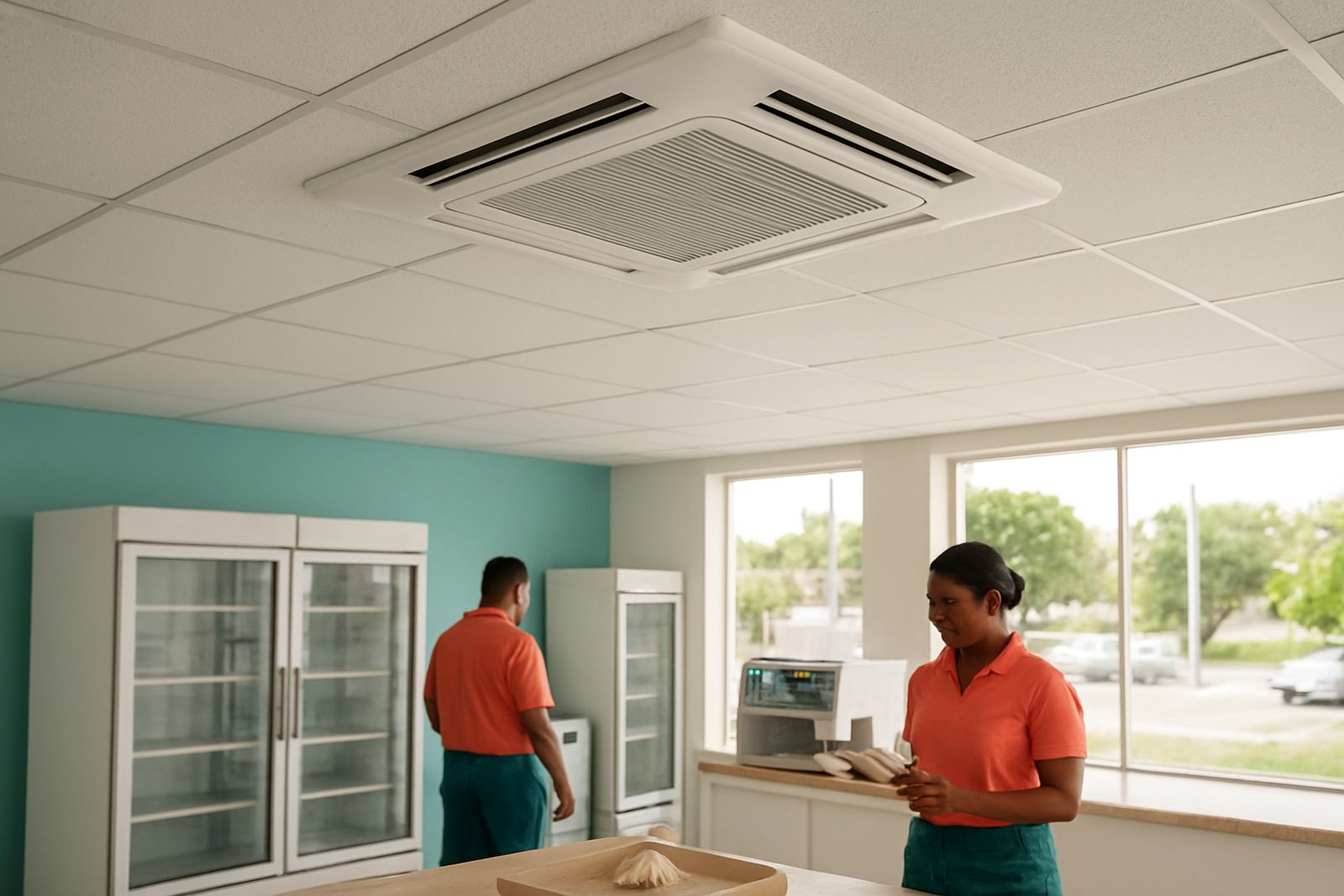
A cassette aircon sits in a suspended ceiling with only the grille showing below. It throws conditioned air in more than one direction, which helps a room feel even instead of having one cold corner and one warm patch. That makes it a practical choice for boardrooms, salons, retail floors, medical rooms, restaurants and training areas where people move around and the seating plan changes often.
Because the unit is tucked into the ceiling, it keeps wall space clear for shelving, glass, signage or stock. It also looks tidy in spaces where a split wall unit would be too obvious. For Durban and coastal KZN, cassette units are often chosen in rooms that need regular cooling through humid months and hot afternoons, especially when the space has lots of people or heat from lighting and equipment.
Sizes, airflow patterns and common options
Cassette units are normally selected by cooling capacity, airflow pattern and ceiling depth. Smaller models suit compact offices and consultation rooms, while larger 4-way cassette units are used in bigger open-plan areas. The right size depends on room volume, glazing, occupancy and heat load, not just floor area. A 30 m² room with full sun can need very different cooling to a shaded room of the same size.
- Typical capacities: 2.5 kW to 14 kW for most commercial rooms, with larger systems available for bigger spaces.
- Air distribution: 4-way blow, 2-way blow, or adjustable louvre patterns for long rooms and awkward layouts.
- Controls: wall controller, wired thermostat or centralised control where several units work together.
- Drainage: gravity drain where possible, or a condensate pump if the ceiling space is tight.
Some models offer fresh air connection, higher static pressure fan settings, or a quiet mode for meeting rooms and front-of-house areas. In salty coastal air, the coil finish and casing protection matter too, because corrosion can shorten service life if the unit is not matched properly to the site.
Where cassette units suit best in KZN
These units work well in spaces that need clean lines and even comfort. In Durban North and Umhlanga they are often installed in offices, reception areas and boutique retail spaces. In Ballito and along the South Coast, they suit holiday accommodation, restaurants, surf shops and estate clubhouses. In Pinetown, they are common in light industrial admin blocks, workshops with air-conditioned offices, and staff areas that need reliable cooling during load-shedding recovery.
They are a strong option where walls are already spoken for, or where the room has a central ceiling bay that can carry the unit and pipe run. They also help in spaces with several heat sources, because the multi-directional airflow reduces hot spots better than a single wall throw. If the ceiling is low, or the roof space is crowded with services, a site visit is needed before sizing is confirmed.
- Good for open-plan offices and call centres.
- Useful in shops, salons and waiting rooms.
- Well suited to restaurants and hospitality areas.
- Can serve classrooms, studios and training rooms.
Installation needs, power supply and refrigerant lines
A cassette aircon needs enough ceiling depth, a sound mounting point and clear access for the drain, power and refrigerant pipework. The installer must check the ceiling structure, route of the pipes, service access panel and where the condensate water will go. If the drain cannot fall away naturally, a pump may be required. That point is often missed on quick quotes and then becomes a problem later.
Most commercial cassette systems run on 230 V single phase for smaller units, while larger systems may need 400 V three phase supply. Correct cable sizing, breaker protection and isolator placement should always be checked against the unit data and the site conditions. In areas with frequent trips or unstable supply during load-shedding, surge protection and proper restart control are worth planning for. Refrigerant pipe length, vertical lift and gas charge also need to be kept within the manufacturer limits, otherwise performance drops and faults start showing up.
We also check for service access around the ceiling opening, because a unit that cannot be reached properly will cost more to maintain. That is a common issue in offices where the ceiling was closed before the aircon plan was finalised.
Care, cleaning and planned servicing
A cassette unit needs regular filter cleaning and periodic coil servicing to keep airflow strong. In Durban’s coastal air the filters can load up quickly with dust, salt and fine debris, especially near roads or workshop entrances. If the airflow drops, the room starts pulling harder on the system and running costs climb.
Planned maintenance helps prevent nuisance breakdowns, water drips and warm-air complaints. During a service we typically check temperatures, airflow, drain function, electrical terminations, coil condition and thermostat response. If the unit is part of a business that cannot afford downtime, a service contract makes sense because it keeps the check dates regular and gives you a record for your maintenance file.
- Wash or replace filters on schedule.
- Check drain pans and condensate lines for blockages.
- Inspect fan motors, belts where fitted, and electrical connections.
- Test temperature split and system pressures.
- Clean coils before salt and dust build up too far.
What to check before you place an order
Before ordering a cassette aircon, it helps to confirm the room size, ceiling type, heat load and how the space is used during the day. A room with west-facing glass in Umhlanga will not need the same solution as a shaded internal office in Pinetown. The more detail you give upfront, the better the unit choice and the lower the chance of callbacks.
Please check the following details before you ask for a quote:
- Room length, width and ceiling height in metres.
- Whether the ceiling is plasterboard, grid type or exposed structure.
- How many people use the room, and what equipment adds heat.
- Whether the unit will need fresh air, pump drainage or long pipe runs.
- Power supply available, single phase or three phase.
- Any noise limits, after-hours working rules or landlord approval needed.
For commercial sites, it also helps to know if the business needs compliance records, service logs or out-of-hours installation. We work from Glen Anil and cover Durban, Durban North, Umhlanga, Ballito, Pinetown and the South Coast, with service support for breakdowns and scheduled maintenance.
Key facts
| Type | Ceiling cassette air-conditioning for commercial and light industrial spaces |
|---|---|
| Typical capacity range | 2.5 kW to 14 kW per unit, larger systems on request |
| Air distribution | 2-way or 4-way airflow depending on room shape |
| Power supply | 230 V single phase or 400 V three phase depending on model |
| Drainage | Gravity drain or condensate pump where required |
| Common applications | Offices, retail, salons, restaurants, waiting rooms and training spaces |